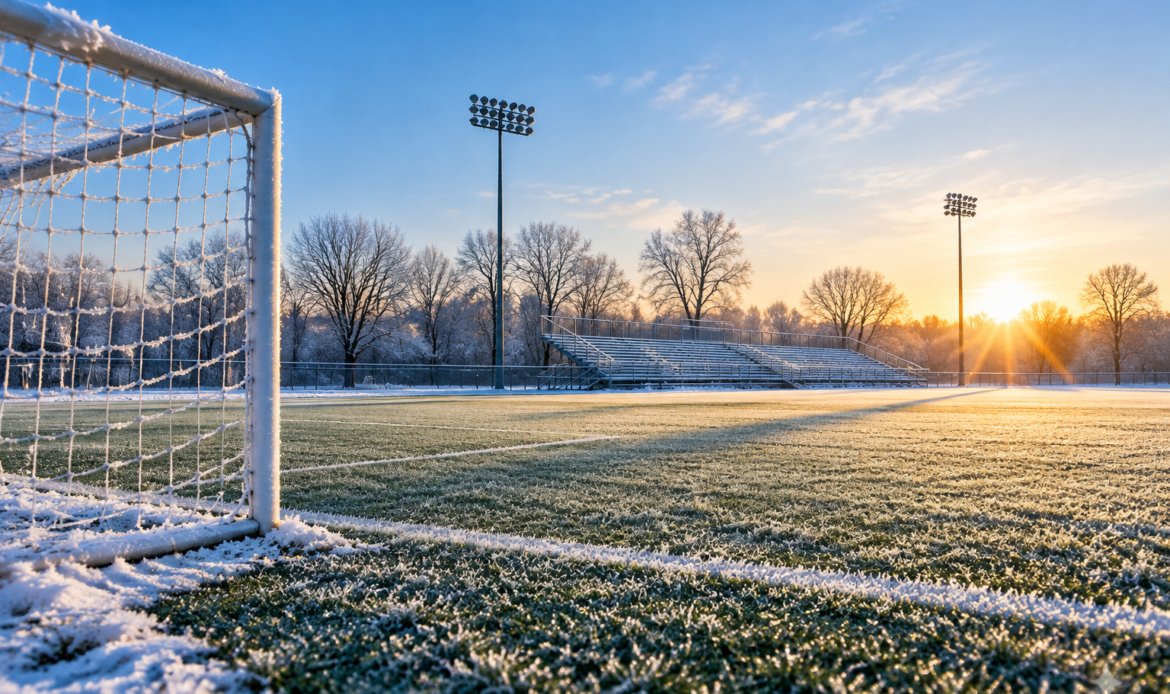
By the time a youth soccer league calls to book spring field time, the damage is already done. Frost heave has lifted a section of infield edging, compacted turf around the goal mouth has gone bare, and nobody can find the inspection record from October. The scramble to assess, repair, and document everything in four weeks costs more than a consistent winter inspection routine ever would.
Winter is not an off-season for sports field management. It is a slow accumulation of risk. Parks and recreation directors who treat it that way will open fields on schedule in spring. Those who do not will spend April playing catch-up.
Why Winter Is Hard on Sports Fields
Freeze-thaw cycles are the most destructive force a natural turf field faces. Water works its way into the soil, freezes, expands, and then contracts. Repeat that process dozens of times between November and March and the result is uneven surfaces, cracked edging, shifted bases, and damaged drainage infrastructure.
Synthetic turf is not immune either. Seams can lift when infill shifts. Anchoring systems around perimeter edges loosen. Surface hardness changes in cold temperatures, raising concerns about impact attenuation that matter when inspections resume in spring.
Beyond turf, winter takes a toll on:
- Goal posts and their anchor sleeves
- Bleacher frames and footing hardware
- Fencing and windscreen attachments
- Dugout roofing and benches
- Field lighting poles and fixtures
- Irrigation system components
None of these failures happen overnight. They develop gradually, which is exactly why periodic winter inspections matter. Catching a cracked anchor sleeve in January is a simple repair. Missing it and opening the field anyway is a liability event waiting to happen.
The Documentation Gap That Creates Audit Problems
Many parks departments do perform some level of winter field checks. Staff walk the fields after major storms, facilities crews look things over before a cold snap lifts. The problem is almost never observation. It is documentation.
When a risk manager or municipal auditor asks for the inspection history on a field where an injury occurred, paper logbooks that may or may not have been completed consistently are not a defensible record. Neither is a text message thread or a note someone remembers writing but cannot locate.
A defensible inspection record includes who performed the inspection, the date and time, the specific assets checked, the condition found, any deficiencies noted, and what action was taken or assigned. Without all of those elements, the inspection might as well not have happened from a liability standpoint.
This is where a structured digital workflow makes a measurable difference. Using a platform like ParkZapp, inspectors complete standardized checklists on a mobile app in the field. Every entry is timestamped, tied to a specific asset, and stored in an admin panel that any authorized staff member or auditor can access. There is no paper to lose and no ambiguity about who did what and when.
Building a Winter Sports Field Inspection Routine
A practical winter inspection program does not require daily visits to every field. It requires a clear schedule, a consistent checklist, and a reliable way to record and act on findings.
Set a Minimum Inspection Frequency
At minimum, sports fields should receive a formal documented inspection once a month during the off-season. After significant weather events — heavy snow loads, ice storms, or hard freezes followed by rapid thaws — an additional check is warranted. Post-storm inspections do not need to be exhaustive, but they should cover the highest-risk items: goal post anchors, perimeter fencing, bleacher footings, and turf surface conditions.
Standardize What You Check
Consistency is the foundation of useful inspection data. When every inspector uses the same checklist and the same condition ratings, you can compare findings across time and across fields. A standardized checklist for winter sports field inspections should cover:
- Turf surface evenness and condition, including bare spots and heaving
- Goal post stability, hardware, and anchor condition
- Synthetic turf seam integrity and infill displacement where applicable
- Bleacher structural condition and hardware corrosion
- Fencing stability and gate hardware
- Drainage inlets and outfall visibility
- Lighting pole condition and visible fixture damage
- Dugout or bench shelter condition
- Signage legibility and mounting security
Checklists built into a platform like ParkZapp can be tailored to each specific field or facility type, so inspectors are not working from a generic list that may miss site-specific assets.
Link Findings to Work Orders Immediately
An inspection finding that sits unassigned for two weeks is a liability. The whole point of consistent documentation is that it drives action. When an inspector notes a loose goal post anchor in January, that finding should immediately generate a work order assigned to the right crew with a due date tied to field reopening requirements.
ParkZapp’s work order functionality connects directly to inspection findings, so nothing gets lost between the person who identified a problem and the person responsible for fixing it. That closed loop — from inspection to work order to resolution — is what transforms documentation from a compliance exercise into actual risk reduction.
Preparing for Spring Reopening From Day One of Winter
The best spring reopening strategy starts in November. When every winter inspection is documented and every deficiency is tracked through to resolution, the spring readiness assessment becomes a review rather than a discovery process.
Instead of walking fields in March wondering what shape they are in, your team can pull up an asset history that shows every condition note from the past four months. You will know which fields need surface repair before reopening, which assets need parts already on order, and which fields are ready to go. That kind of visibility changes the conversation with coaches, leagues, and community users who want to know when fields will open.
It also changes the conversation with your municipal risk manager. When a claim arises — and in parks and recreation, claims do arise — a complete inspection and work order history is your strongest defense. It demonstrates that your department operated with reasonable care throughout the off-season, not just during peak use periods.
Assign Ownership and Train Your Team
A sports field inspection program is only as reliable as the people carrying it out. Assign clear ownership for each field or complex. Make sure every inspector knows how to use the digital checklist, how to log a deficiency, and how to initiate a work order when something needs repair.
Brief refresher training at the start of the winter season takes less than an hour and pays dividends in data quality all winter long. When inspectors understand that their documentation directly supports the department’s liability position and spring planning, compliance with the routine improves.
Use Your Data Before Spring Arrives
Mid-winter is a good time to review cumulative inspection data across your sports field inventory. Look for patterns: fields with repeated drainage issues, assets that keep generating findings, or areas where the same deficiency gets logged but never fully resolved. That analysis informs your capital planning conversation and helps prioritize maintenance budgets before spring bids go out.
ParkZapp’s admin panel gives managers a view across all assets and inspections, making it straightforward to spot trends without manually compiling spreadsheets from paper records.
Start Now, Not in March
Every week of winter that passes without a documented inspection is a week of risk that cannot be recovered later. The fields your community counts on in spring are accumulating wear right now, and the documentation that protects your department in a claim is either being built or it is not.
A consistent winter inspection routine — standardized checklists, mobile documentation, linked work orders, and an accessible audit trail — is not a heavy lift. It is a habit. And it is the kind of habit that makes spring reopening smoother, faster, and far less stressful for everyone involved.
If you want to see how ParkZapp can support your sports field inspection and documentation workflow this winter, request a demo at parkzapp.com and we will walk you through it.