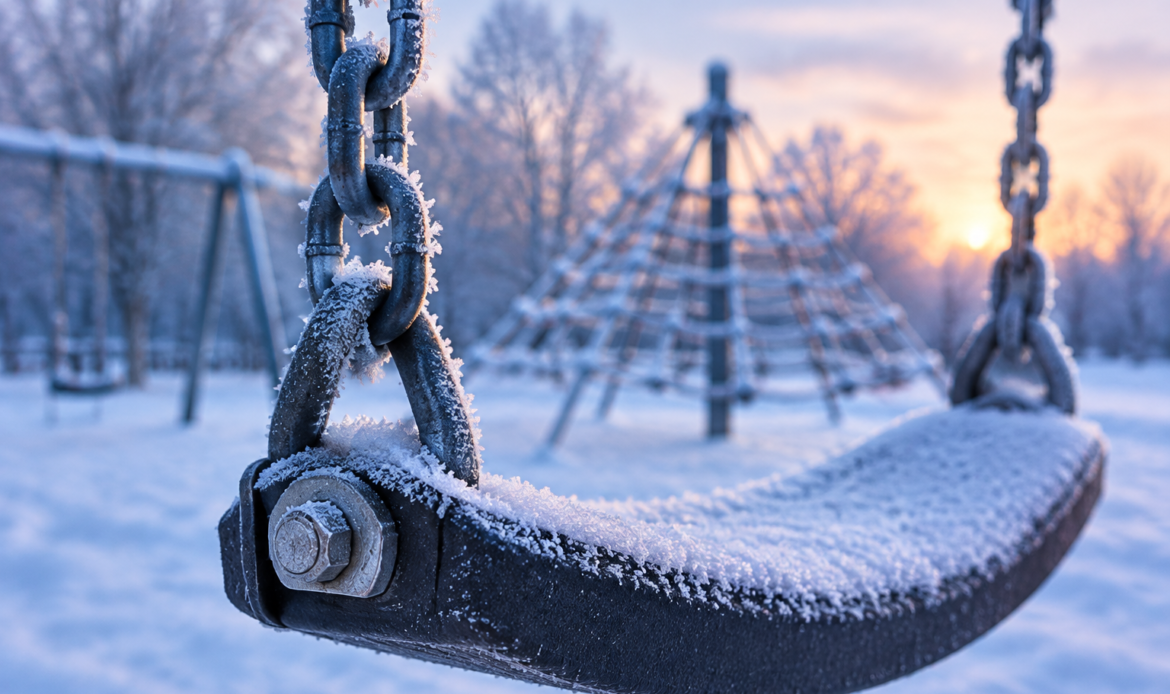
A single missed inspection entry can unravel months of solid maintenance work the moment a liability claim lands on your desk. In winter, when playground conditions change fast and staff schedules get stretched thin, documentation gaps are more common — and more costly — than most parks departments want to admit.
Why Winter Is the Riskiest Season for Playground Documentation
It’s tempting to assume that reduced playground use in winter means reduced risk. In practice, the opposite is often true. Freeze-thaw cycles crack surfacing, shift footings and loosen hardware. Ice accumulates on platforms and climbers. Drainage problems that were manageable in fall become serious hazards once temperatures drop.
Meanwhile, inspection frequency tends to drop alongside the temperature. Staff are pulled toward snow removal, facility heating and rink operations. Playground inspections get squeezed to the margins — and when they do happen, the documentation is often rushed, incomplete or stored somewhere it can’t be retrieved quickly when an auditor or risk manager asks for it.
That combination — elevated hazards plus thinner documentation — is exactly what creates liability exposure.
What CPSC and ASTM Guidance Expects Year-Round
Both the CPSC Public Playground Safety Handbook and ASTM standards make clear that playground inspections are not a warm-weather-only responsibility. Routine inspection obligations do not pause for the calendar. Equipment that remains accessible to the public — even informally, even when officially closed — still needs to be monitored and documented.
That means your inspection records need to demonstrate:
- Regular, dated inspection visits throughout the winter months
- Documented findings for each piece of equipment and surfacing area
- Clear records of any hazards identified and the corrective action taken
- Work orders or repair logs that tie a finding to a resolution
- Sign-off from a qualified inspector where required
Canadian departments operating under CSA standards face similar expectations. The standard does not carve out an exemption for cold weather. If the equipment is in place, the documentation obligation stands.
The Four Most Common Winter Documentation Failures
Understanding where records break down helps you close the gaps before an audit or incident forces your hand.
1. Inspection visits that happen but don’t get recorded
A maintenance worker walks the playground, notices ice on a climbing structure, and salts it. No entry is made. As far as any auditor or plaintiff’s attorney is concerned, that visit never happened. Undocumented inspections provide zero liability protection.
2. Findings logged without follow-through records
An inspector notes cracked surfacing under a swing bay. A work order gets submitted verbally. The repair happens two weeks later. But the original finding, the work order and the confirmation of repair never connect in a single retrievable record. The documentation trail is broken.
3. Paper forms that disappear before they’re filed
Paper-based inspection workflows are particularly vulnerable in winter. Forms get wet, torn or left in a vehicle. Photos taken on a personal cell phone don’t make it into any official record. When the season ends, there’s no reliable archive — just a partial stack of forms and a lot of uncertainty.
4. No clear ownership of who inspects what and when
When inspection responsibility isn’t formally assigned, winter coverage tends to fall through the cracks between departments. Public works handles snow removal. Parks handles programming. Nobody owns the playground inspection. By February, it may not have been formally documented since November.
Building a Winter Inspection Workflow That Holds Up
A reliable winter inspection workflow doesn’t require a large team or a complex system. It requires consistency, clear ownership and documentation that is captured at the point of inspection — not reconstructed later.
Set a fixed winter inspection schedule and assign it in writing
Define your inspection frequency for each playground location during the winter months. Assign a named staff member or inspector to each location. Put the schedule in writing. When the schedule is documented and assigned, missed visits become visible — which is exactly when you want to catch them.
Use standardized checklists for every visit
A checklist forces completeness. It ensures your inspector covers surfacing depth and condition, structural hardware, entrapment hazards, ice accumulation on elevated surfaces, drainage around footings and equipment accessibility. Without a checklist, inspections naturally drift toward whatever is most obviously wrong and skip the rest.
Capture photos at the point of inspection
Photos tied to a specific asset, location and date are among the most defensible pieces of documentation you can produce. A photo of intact surfacing taken the week before an incident is worth far more than any after-the-fact explanation. Make photo capture a required part of every inspection, not an optional add-on.
Connect findings to work orders immediately
Every hazard finding should generate a work order on the spot. The work order should reference the specific asset, describe the finding and track progress through to completion and sign-off. That closed loop — inspection finding, work order, repair confirmation — is what an audit is looking for.
How Digital Tools Strengthen Winter Documentation
Paper-based systems work against you in winter conditions. A mobile digital inspection tool changes the equation significantly. Inspectors can complete checklists, attach photos, flag hazards and generate work orders from the field — in real time, regardless of weather.
ParkZapp is built for exactly this kind of workflow. The mobile app lets inspectors work through digital checklists aligned with CPSC, ASTM and CSA standards, attach timestamped photos to specific assets and submit findings that flow directly into the work order system. The admin panel gives parks directors and risk managers a live view of inspection status across all locations — so gaps in coverage become visible before they become a liability problem.
When an auditor requests documentation, there’s no scramble. Every inspection record, photo, work order and repair confirmation is stored and searchable. The archive builds itself as the season progresses.
Preparing for a Mid-Season Audit
Risk managers and insurance carriers don’t always wait for spring to review your records. If your department faces a mid-winter audit — or a sudden incident review — you need to be able to produce clean documentation quickly.
Ask yourself these questions now:
- Can you pull up every inspection record for a specific playground going back to November?
- Is every open hazard finding connected to a work order with a current status?
- Do your records show who conducted each inspection and when?
- Is there a documented process for how findings get escalated and resolved?
If any of those answers are uncertain, the time to fix it is before an incident — not after.
Start the New Year Audit-Ready
Winter playground inspections are not about checking a box. They are about maintaining a defensible, continuous record of responsible stewardship over public equipment. The departments that do this well don’t scramble when a claim comes in. They pull up the records, show the documentation trail and move on.
That outcome starts with the right workflow and the right tools in place before the season gets away from you.
If you want to see how ParkZapp can help your department document winter playground inspections and stay audit-ready all season, request a demo at parkzapp.com/parkzapp-demo.